Superfans Aren't All the Same

Luminate's latest data breaks down how superfan behavior shifts across generations.
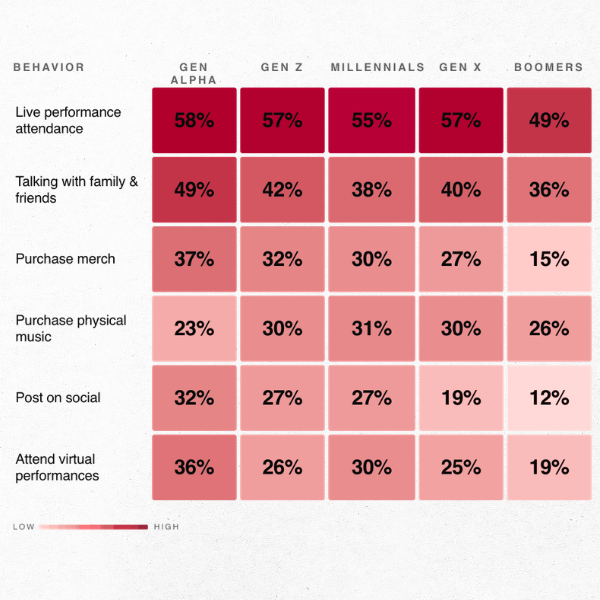
Live performance is the one thing that holds across every group.
Attendance rates run from 49% among Boomers to 58% among Gen Alpha, consistent enough that it's the clearest fixed point in the data. Everything else starts to fragment.
Merch is where the generational split gets sharper.
37% of Gen Alpha superfans buy it; for Boomers, it's 15%. Social posting follows: 32% for Gen Alpha, 12% for Boomers. Virtual performances drop from 36% to 19%. The further you get from digital-native behavior, the steeper the drop.
Physical music is the odd one out.
Gen Alpha is the lowest at 23%, while Gen Z, Millennials, and Gen X all cluster around 30%. Boomers come in at 26%. The vinyl and CD resurgence is real, and it's not being driven by the youngest fans.
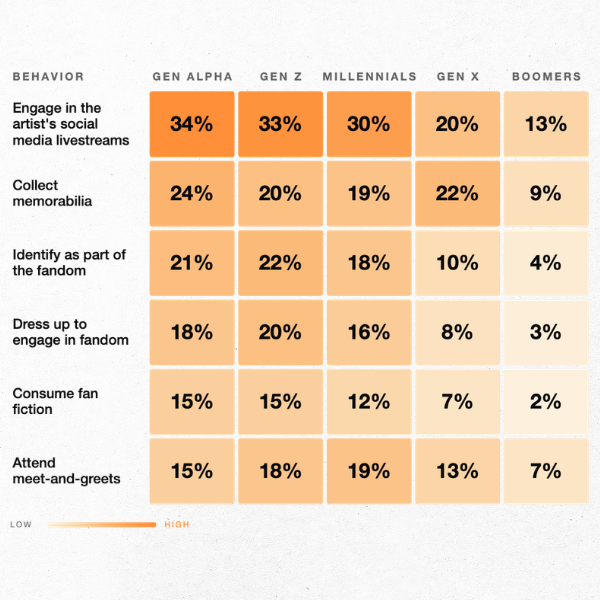
The community identity gap is the most pronounced.
Only 4% of Boomer superfans identify as part of a fandom. For Gen Z it's 22%, Gen Alpha 21%. Older fans are just as devoted. They just don't define themselves by it.
Gen X is worth paying more attention to than most fan strategies currently allow.
They outpace Gen Z on memorabilia collection (22% vs. 20%), and 20% say they intend to engage via social media livestreams.
The industry's superfan conversation defaults to young, digital, and community-driven, because that's where the energy is loudest. But the Luminate data suggests that framing is leaving money on the table. A 45-year-old who buys vinyl, attends every tour, and collects memorabilia is a superfan. Looks like the product strategy has some catching up to do.