Nobody wants to be “featuring” anymore

Eleven songs have reached No. 1 on the Hot 100 for the first time this year. None of them is credited “featuring.” The most recent one that was is Morgan Wallen’s “What I Want” featuring Tate McRae, which first hit No. 1 on the chart dated May 31, 2025.
For most of the last 25 years, that would have been hard to imagine. So we went through every Billboard Hot 100 chart since 1958 to see how the feature credit grew, when it peaked and what happened next.
Twenty years at the top
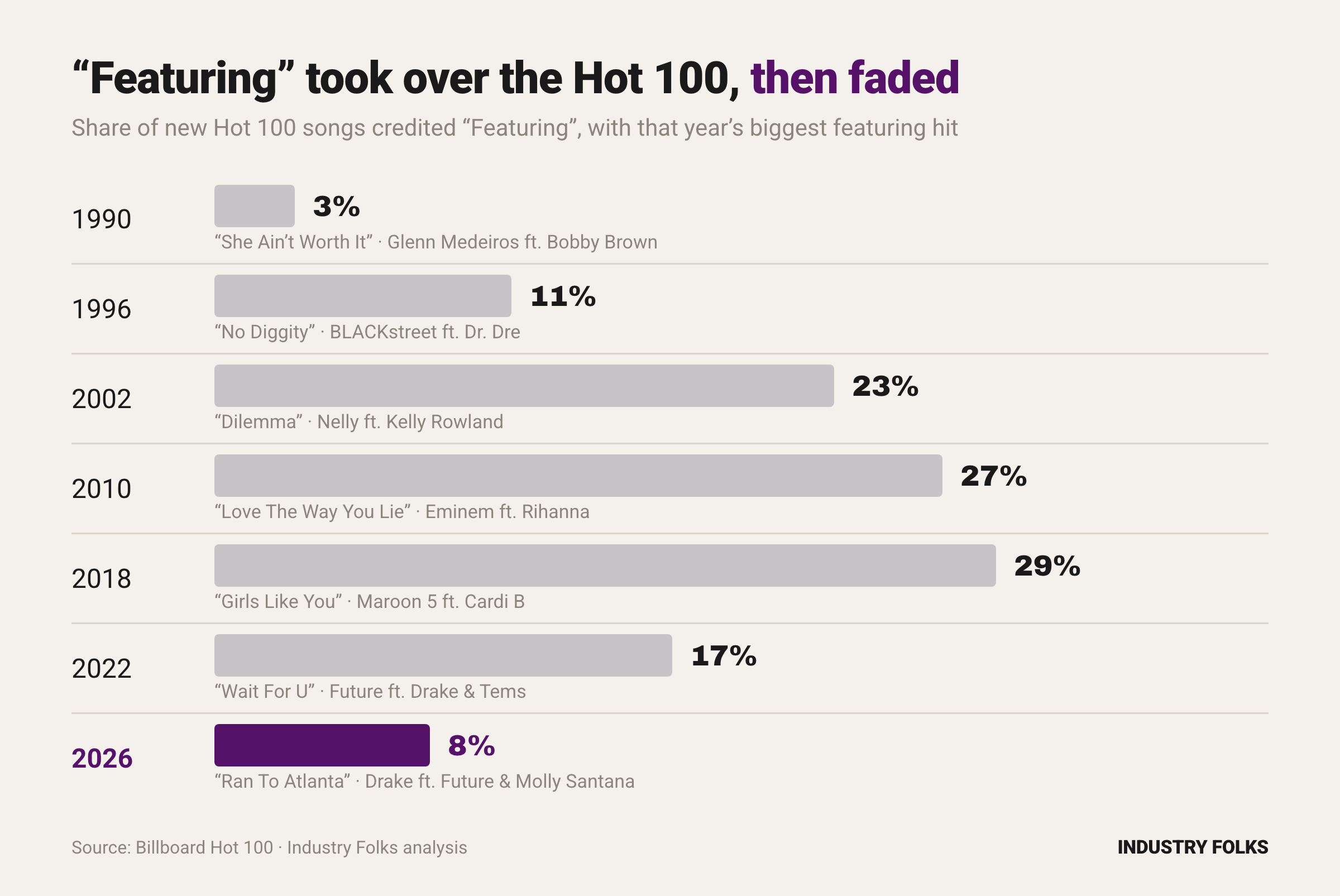
Until the 1990s, “featuring” barely existed on the chart. In the 1960s, 1970s and 1980s, about 1% of new songs carried the credit.
Then it took off. In 1996, the year of BLACKstreet’s “No Diggity” featuring Dr. Dre, 11% of new Hot 100 songs were features. By 2002, the year of Nelly and Kelly Rowland’s “Dilemma,” it was 23%. The share peaked at 31% in 2017 and was still at 29% in 2018, when Maroon 5 and Cardi B’s “Girls Like You” spent seven weeks at No. 1.
The credit was even more common among the biggest songs. In 2010 and 2011, more than 4 in 10 new top 10 hits were features.
This year it’s 8% of new songs. Among this year’s 38 new top 10 hits, only one is credited “featuring”: Drake’s “Ran To Atlanta” with Future and Molly Santana, which peaked at No. 2.
First, the billing changed
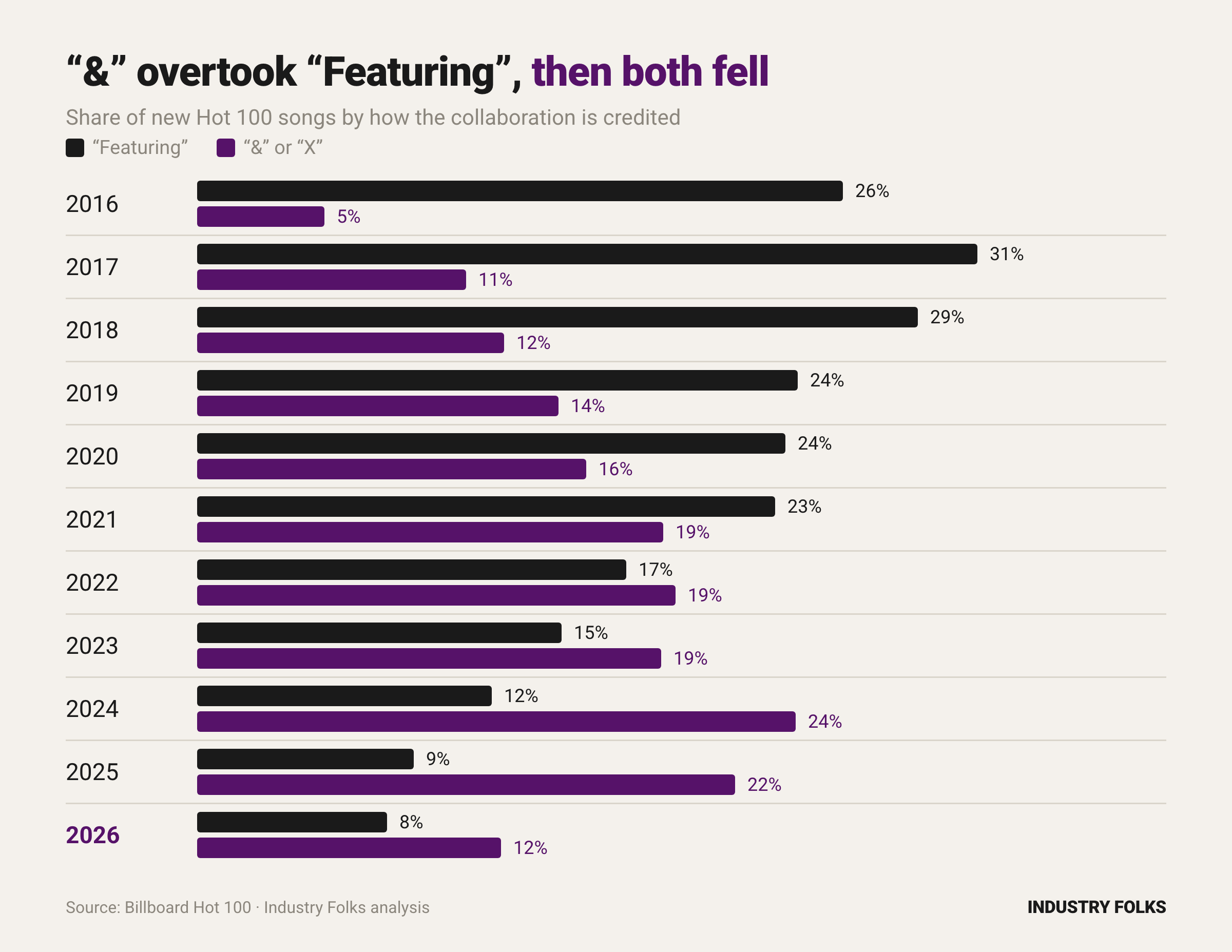
The collaboration didn’t disappear right away. At first it changed its name.
In 2018, 29% of new songs were credited “featuring” and 12% were billed as equals, with an “&” or an “X” between the names. By 2024 that had flipped: 12% “featuring,” 24% “&” or “X.” Equal billing passed the feature credit in 2022 and stayed ahead.
The total barely moved during that switch. From 2017 to 2021, about 4 in 10 new songs had more than one artist in the credit, whichever way they were billed.
2026 is different. Both kinds of credit are down. Collaborations of any kind make up 20% of new songs this year, half of what they were from 2017 to 2021. Among this year’s new top 10 hits it’s 13%, or 5 songs out of 38:
- Drake featuring Future and Molly Santana, “Ran To Atlanta” (No. 2)
- Ella Langley & Morgan Wallen, “I Can’t Love You Anymore” (No. 4)
- Tame Impala & JENNIE, “Dracula” (No. 5)
- Drake & Don Toliver, “Solar Eclipse” (No. 5)
- Karol G with Judeline & rusowsky, “BbY WOW” (No. 6)
No. 1 without a feature
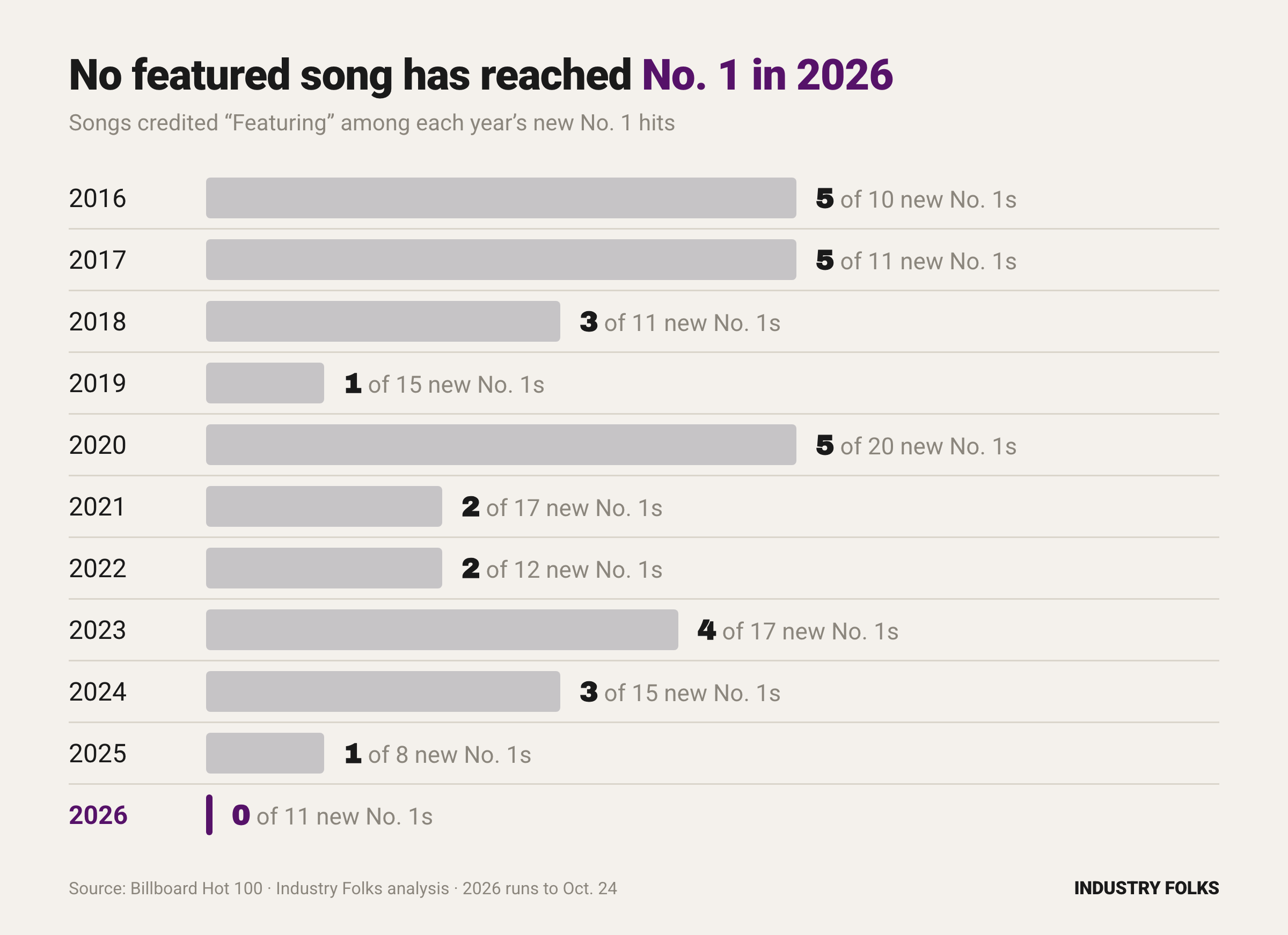
At the top of the chart, the feature credit has been on and off for a few years. Half of 2016’s new No. 1s were features. In 2019 it was one out of 15.
So far, 2026 is the first year since 1998 with no new No. 1 credited “featuring.” None of this year’s new No. 1s is billed with “&” or “X” either. Every song that has reached No. 1 in 2026 is credited to a single act.
The year isn’t over. Our data runs to the Oct. 24 chart, and a feature can still reach No. 1 before December.
Drake is the hub
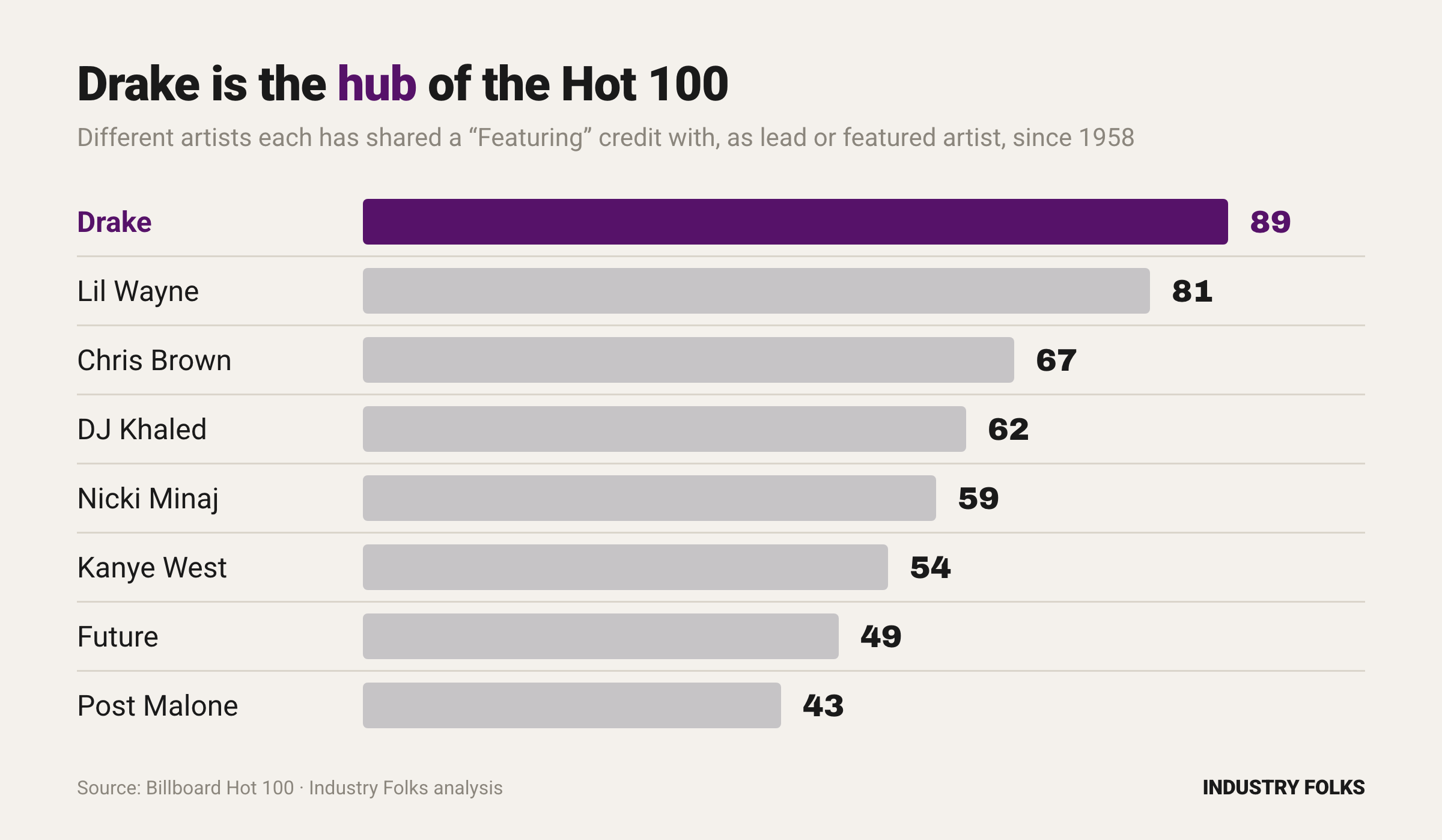
The feature era left behind a dense network, and Drake sits in the middle of it. Counting both directions, artists he featured and artists who featured him, he has shared a Hot 100 feature credit with 89 different acts. Lil Wayne is next with 81.
Lil Wayne has the most appearances as the featured artist, with 98. Drake has 86 and Nicki Minaj 66.
The feature as a launchpad
For many artists, a feature was the way in. We counted 59 artists whose first Hot 100 credit was as a featured act and who later led a top 10 hit of their own. They include:
- Bruno Mars, on B.o.B’s “Nothin’ On You” (2010)
- Nicki Minaj, on Lil Wayne’s “Knockout” (2010)
- Sia, on David Guetta’s “Titanium” (2011)
- The Weeknd, on Drake’s “Crew Love” (2012)
- Sam Smith, on Naughty Boy’s “La La La” (2014)
- Bad Bunny, on Becky G’s “Mayores” (2017)